
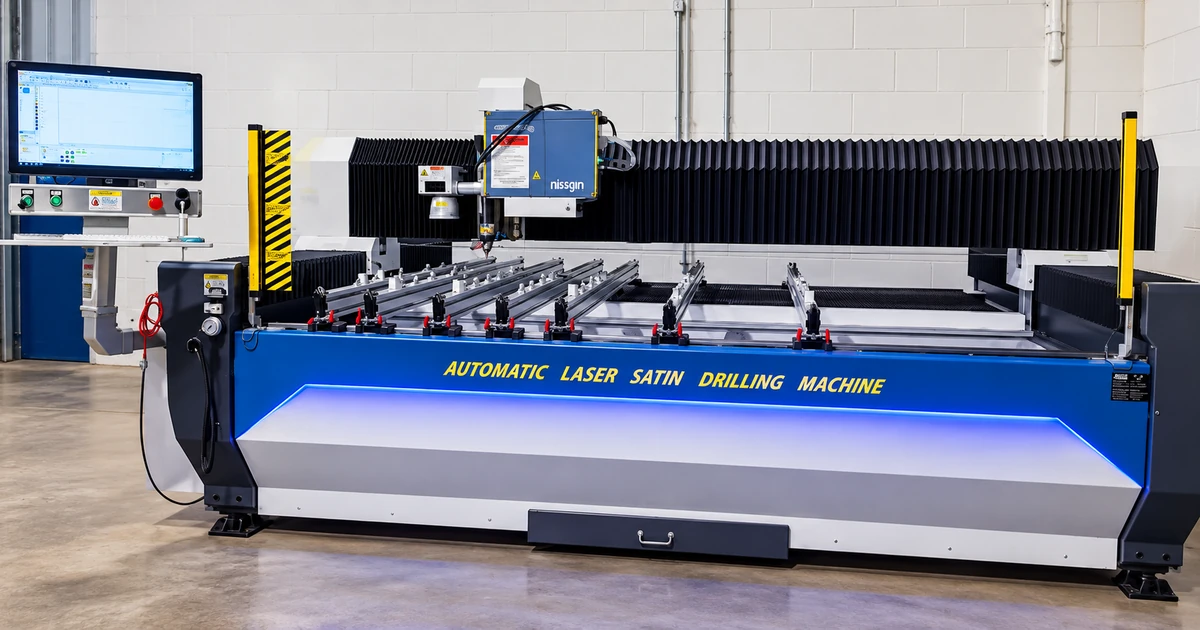
Flat Glass Solutions (FGS) now represents Huaray Precision Laser in the UK, bringing an advanced range of laser sources and integrated glass-processing subsystems to manufacturers looking to add greater design freedom, precision and flexibility to their production capabilities. The technology will enable processors to add bespoke, decorative and high value glass production across fenestration, interiors, furniture and homeware product ranges.
The collaboration gives UK glass processors access to technology capable of marking, engraving, texturing, drilling and selectively removing coatings from glass. For companies seeking to move beyond standard products, it creates new scope to manufacture bespoke designs, personalised pieces and shorter production runs for a broad range of markets.
Potential applications extend from decorative glazing, doors, screens and internal partitions to mirrors, cabinet fronts, tabletops, splashbacks, shelving and glass homewares. The same underlying precision can be used to reproduce patterns, logos, lettering, textures and functional markings, allowing manufacturers to respond to individual briefs without making the design itself dependent on conventional tooling or consumables.
The FGS Huaray portfolio includes nanosecond, picosecond and femtosecond laser technologies across multiple wavelengths and pulse widths. Its glass-processing solutions are designed around the specific application, whether the requirement is detailed surface marking, glass interior engraving, a controlled matte or semi-matte effect, or precision drilling.
Because laser marking is a non-contact process, fine and complex detail can be created without a tool physically bearing down on the glass. In one float-glass marking example, a complex 40mm by 40mm pattern on 2mm glass was completed in 35 seconds, demonstrating the potential to combine customisation with practical production speeds.
The technology may also help manufacturers rethink processes traditionally associated with chemical etching, applied films or sandblasting. In relevant applications, Huaray’s laser sanding technology can create complex designs in a single operation removing the need for sandblasting consumables.
“There is a real commercial opportunity here for UK glass companies,” said FGS Managing Director David Cahill. “We talk a lot about processing glass faster and more efficiently, but growth can also come from being able to produce something different – something more personal, more intricate or better suited to a specific application.
“Huaray’s technology gives processors much more freedom to explore those possibilities. A customer may want a one-off design, a branded pattern, a decorative finish, a specially shaped component or a product that combines visual appeal with a functional marking. The point is that the technology can be configured around what the company wants to make.
“That makes it relevant far beyond one sector. We can see clear opportunities within architectural glass and fenestration, but also in furniture, kitchens, bathrooms, mirrors and homewares. Our role will be to help UK manufacturers understand what is technically possible and identify the Huaray solution best suited to the product and production environment.”
Wuhan-based Huaray Precision Laser develops laser sources and application solutions for high-end manufacturing. Its core capabilities include laser seed sources, pulse electronic control, motion control and application technology, and its products are already used in markets across Europe, the United States and Asia.
The appointment strengthens FGS’s ability to support customers across a wider section of the glass-processing cycle while introducing technology that can help manufacturers diversify, increase the value of their output and enter markets where design flexibility is an important point of difference.